
Where Will the Arrow of Time Land?
One day I will die. After the shock, the bewilderment, and the grief, the people I love who are still alive will return to their lives. The waters of time will close over my head. What will remain on the surface?
There is a beautiful and true answer: the dead live on in the hearts of the living. As Henry Wadsworth Longfellow wrote in “The Arrow and the Song” (which has also been set to music):
Long, long afterward, in an oak
I found the arrow, still unbroke;
And the song, from beginning to end,
I found again in the heart of a friend.
The song survives in a friend’s heart, and the arrow in an oak tree. The recipe for being remembered is simple: write a brilliant song, and people will carry it in their hearts.
But what about the arrow?
Seids, Menhirs, Dolmens, and Megaliths
I don’t know exactly why Neolithic people put up those stones. Perhaps archaeologists and anthropologists have already solved the mystery? I’ll take the liberty of hearing their message anew. Perhaps they were trying to send a single semantic bit into eternity: a quantum of awareness, the flash of a human being arriving in the body of a highly developed primate.
That bit is a question: Why?
Why does the sky turn? Why do my parents die? Why beauty, why love? Why does a wheel on a stick spin so wonderfully? Why are the world and my own body filled to the brim with life?
It was the first human-made arrow of time to hit its mark. Its target was us, here today (and here tomorrow). It also changed its makers’ past, giving it meaning. But that is a story for another day.
New Arrows
We no longer have to stack stones to send something into eternity. We have computers, flash drives, cloud storage, and the Internet. Nothing ever disappears from the Internet. Or does it?
It turns out that things don’t just disappear: they leak away at a startling rate. The half-life of a link on the Internet is about three years. Within that time, half of all new addresses stop working. Pages move, files are deleted, videos go private.
How reliable a cloud service is depends on the political climate, the current state of intellectual-property law, and much else besides. Flash drives get lost, hard drives become obsolete, CDs grow mold, and all of them burn beautifully in a fire. Unless someone keeps refreshing digital information—and, above all, someone is there to refresh it—it disappears as readily as anything else.
So it is hardly surprising that people have turned to other media in search of a long-term channel to the future. Our ancestors did well with megaliths. Could we also send something ten thousand years forward? I’ve collected a few projects that ask what, and how, we might communicate to people living ten millennia from now.
For me, the most interesting part is the what: what meaningful, valuable thing could we tell our distant descendants? Each project has its own answer.
- The Long Now Foundation encourages us to think on the scale of a civilization: the ten thousand years behind us and the ten thousand ahead.
- There is also a Wikipedia article about the foundation.
- “Ten Thousand Years” from 99% Invisible explores the problem of saying anything intelligible to someone living that far in the future. Along with the Long Now project, it is one of the richest discussions I’ve found of why the difficulty is a matter of meaning, not just technology.
- The Arctic World Archive lets you store an archive in a mine beyond the Arctic Circle, for a considerable price. It has also preserved the open-source code from GitHub, free for its authors.
These new megaliths have been built and filled with information. What will become of them in ten thousand years?
We’ll live and see.
A Smile That Fills the Whole Face
I can picture my grandfather, Vasily Titych Nikolaev, only through photographs and documents. He died nine years before I was born. I feel as though I know him a little—or rather, I recognize something of our shared family manner: a mixture of reserve, irony, and gentle curiosity. I know the broad outlines of his life: when he was born, when he married, that he had two children, what he did during the war, and when he died.
But to feel a connection with him, to understand how much I really resemble him, whether I’m carrying on his line or have found something entirely my own, I need—don’t laugh—a high-resolution video of him. I want to see how he walks, turns his head, laughs, talks to someone; to hear him breathe, sigh, clear his throat, sleep.
It is in the body that the information about who we are is encoded, stored, charged with life: how each of us is put together, exactly and particularly, what sets us apart from other families and what binds us to our own. To some people this is obvious, almost a truism (we are our bodies). To others, perhaps, it is anything but obvious (what about all my LiveJournal posts and those three academic papers?). I think the body is the newest arrow of time. Instead of stones, we need to pass ourselves on.
And now I think I can answer the megaliths’ question: why preserve anything for a very, very long time? Because we should preserve the most important thing in the world for ten thousand years:
Our bodies.
From them, our descendants could understand everything we wrote and didn’t write on social media: our relationships with family, work, travel, and politics. As the writer Venedikt Yerofeyev put it (in a rather different context):
To the inquisitive observer (someone like me, for instance), those lines divulged everything there is to divulge about a person and the human heart: every quality, from sexual to professional, every failing, professional and sexual. How well balanced a person was, whether they were capable of betrayal, and every secret of the subconscious, if there were any secrets at all.
— Venedikt Yerofeyev, Moscow to the End of the Line, “Novogireyevo–Reutovo”
Those secrets exist, and so does the curiosity to discover them. All that remains is to deliver the body, intact, to those curious descendants.
The Nikolaev Tablets
Of course, I don’t mean sending a mummy, or anything like a fully sequenced genome. Those are only husks or imprints of a body, however detailed. What we need is the life of the body. The best we can do today is to preserve plenty of good photographs and videos of ourselves, well shot and recorded, in different situations: moving, talking, singing, laughing, dancing, feeling, paying attention, working.
Then our descendants can decode these messages and relate them to their own lives, taking from them whatever they need.
So much for what to pass on. Now, how do we do it?
Let’s answer the obvious question straight away: “Can’t I just save it to a flash drive and leave it at home, or upload it to Dropbox?” Of course you can, and should. I just doubt it will last very long. Once the person looking after an archive stops tending it, it falls apart, becomes unreadable, or is deleted by a service provider. I learned that the hard way when I could no longer pay for my Amazon storage in February 2022.
As for flash drives, look up SLC NAND: a reliable, very expensive kind of flash memory. Ordinary consumer drives are built to minimize the price per megabyte, not to keep data safe for generations. If you don’t know what kind of drive you have, it isn’t SLC.
Let’s focus on storage that stands a real chance of lasting. If you want something done well, do it yourself. For instance:
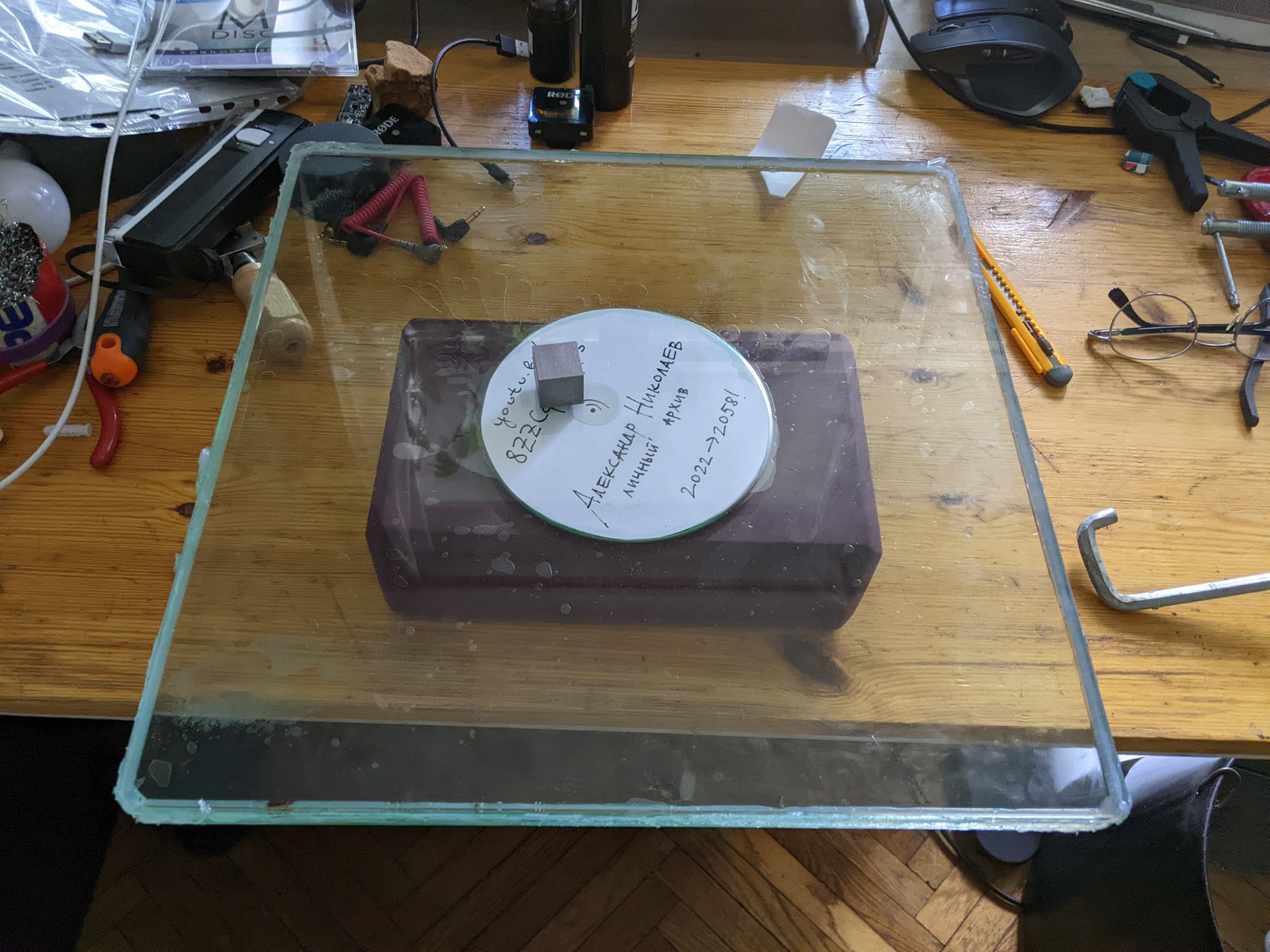
- The data goes onto an M-DISC, a type of Blu-ray disc designed for long-term archiving, with a claimed lifespan of around a thousand years. One disc holds 100 GB; its specified storage temperature can reach 80°C, even in direct sunlight.
- The disc sits in a pocket inside a laminated stack of toughened glass bonded with a special adhesive. The stack is sealed and meant to survive outdoors. To retrieve the disc, the glass must be broken, so PTFE spacers protect it. Toughened glass breaks into the familiar small pieces, which should make retrieval safer.
- The glass tablet goes somewhere quiet and remote. Friends and I installed our first tablets on a small island in the White Sea.
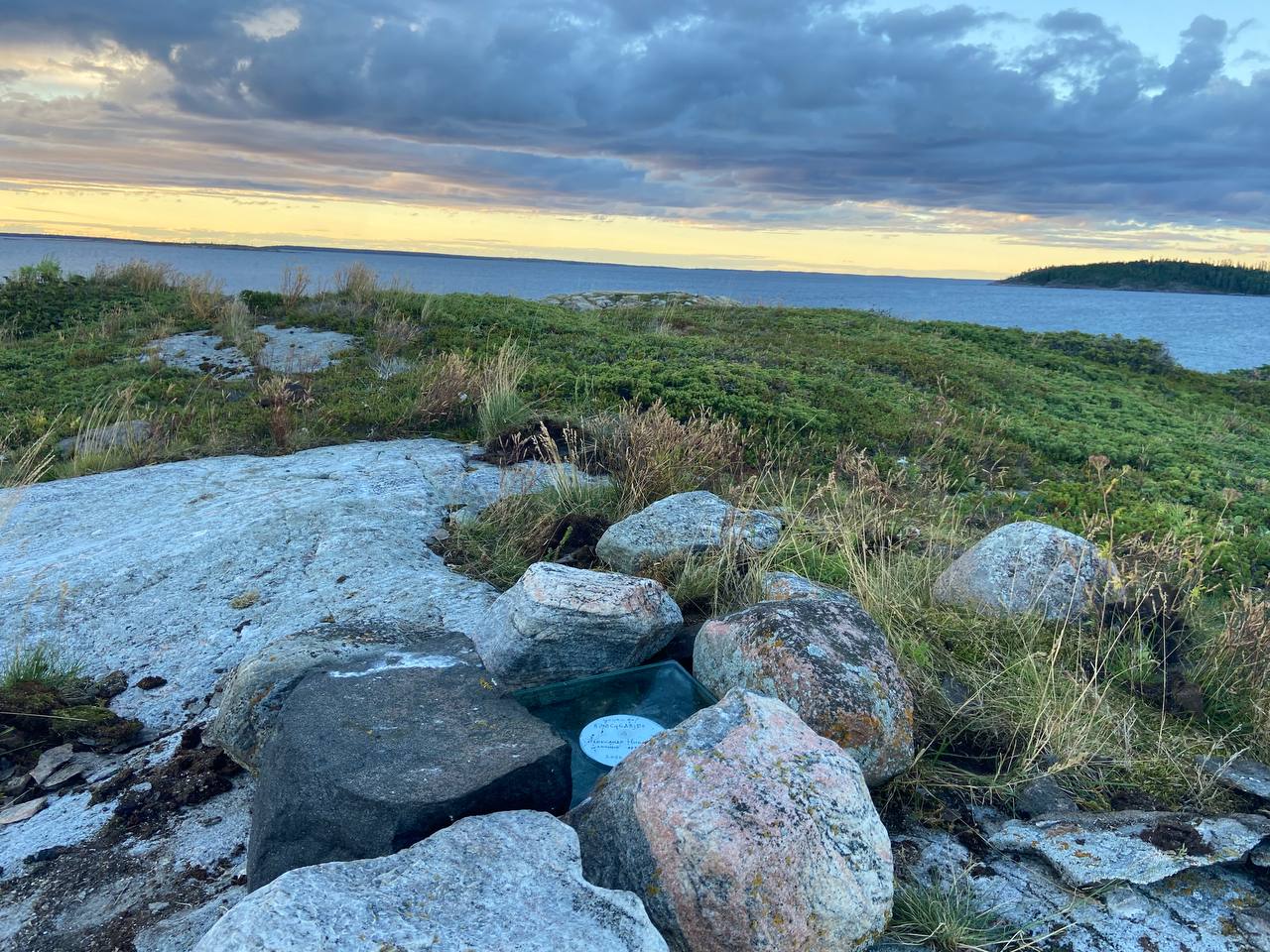
Some other things mattered to me about the tablets:
- They should be environmentally benign: they shouldn’t become litter or react chemically with their surroundings.
- They should be practically useless as physical objects. No metal worth selling for scrap or repurposing; neither conveniently small nor impressively large.
- They needn’t be particularly beautiful, either. Better not to stir strong aesthetic or religious feelings with inscriptions and the like. The object should be unremarkable: not like rubbish, but like a large stone among many.
I like what we made, and I’d like to install a couple more tablets on other continents. It pays to plan for resilience against extinction-level events.
We’re not dinosaurs, after all.
If time is a slow-flowing river,
We’ll fold a paper boat and find an old man.
Let him float, rowing lightly downstream—
Our old man, at last, has reached the river.
P.S.
I’d love to hear what you think of this essay and the tablet project. I’ve left plenty of questions outside the scope of this account, including:
- How should the glass be bonded?
- How should the data be prepared?
- How should a storage site be chosen and arranged?